
If you have spent any time browsing social media lately, you have likely encountered images that seem to defy the laws of the jungle. A capybara (the world’s largest rodent) sitting calmly on the back of a toothy caiman, or lounging just inches away from a sunbathing alligator. It is a sight that challenges our basic understanding of the food chain and predator-prey dynamics.
At Capybara Happiness, we are fascinated by these Ambassadors of Chill and their ability to maintain a peaceful presence in even the most dangerous company. While these photos often go viral as memes about enlightened rodents, the reality is rooted in a fascinating mix of biology, ecology, and calculated survival strategies.
To understand this phenomenon, we have to look past the cute factor and examine the scientific reasons why these animals coexist so frequently. Here is the deep dive into why capybaras are so relaxed around some of the world’s most efficient predators.
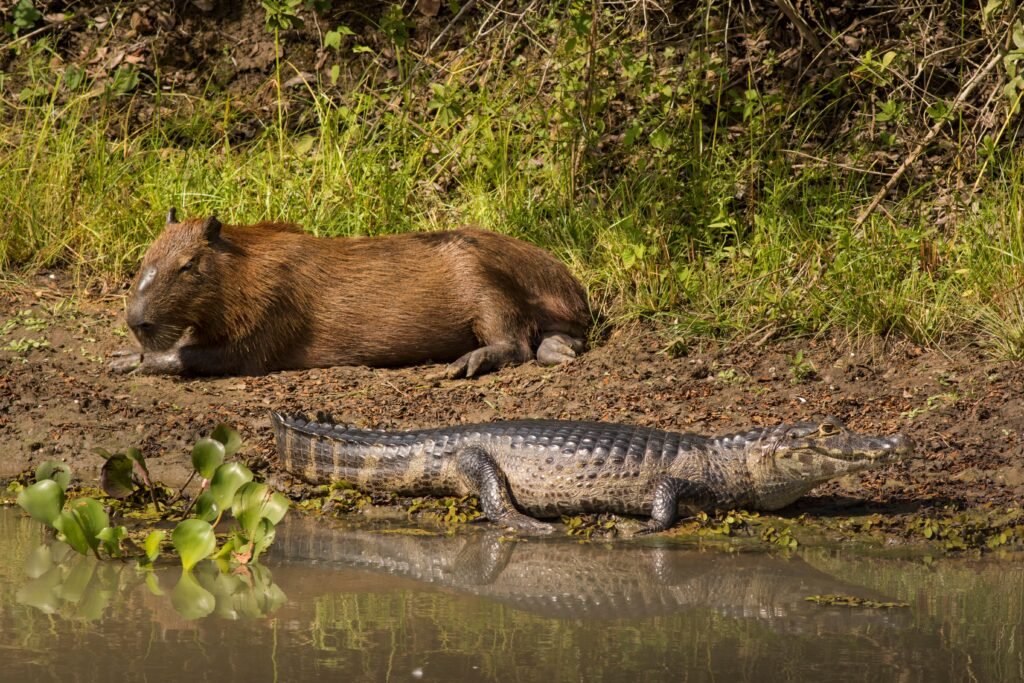
Identifying the Neighbors: Caimans vs. Alligators
First, it is important to clarify the players in this interaction. While people often use the term alligator as a catch-all, most of these viral interactions occur in South America, particularly in the Pantanal and Amazon basins. In these regions, the capybara habitat sharing primarily involves the caiman.
Caimans are members of the Alligatoridae family, making them close cousins to the American Alligator. However, they are generally smaller and have different dietary preferences than their larger North American relatives. This distinction is crucial when analyzing why a capybara feels safe enough to use a reptile as a literal footstool.
In the wetlands of South America, space is often limited, especially during the dry season. When water levels drop, all animals are forced into smaller shared territories. This proximity creates a truce necessitated by the environment rather than a choice of friendship.
The Science of Satiation: Why Predators Don’t Always Attack
One of the primary reasons for the perceived fearlessness of the capybara is the metabolic reality of the predator. Unlike mammals, which must eat constantly to maintain body heat, reptiles like caimans are ectothermic. Their metabolism is significantly slower, meaning they do not need to hunt every day.
A caiman that has recently consumed a large meal of fish or a small bird simply does not have the motivation to attack a 100-pound rodent. Hunting an adult capybara is a high-energy task that involves a significant risk of injury to the predator. If the caiman isn’t hungry, it will prioritize energy conservation over a difficult hunt.
Furthermore, capybaras are surprisingly formidable. They possess sharp, constantly growing incisors and are incredibly fast in the water. For a predator, a healthy adult capybara is a high-cost meal. This is a key factor in capybara fearlessness explained, as the rodents seem to sense when a predator is in power-save mode.
Capybara Natural Predators: Assessing the Real Risk
While the internet loves the capybara and alligator narrative, the reality of capybara natural predators is much more intense. In their natural environment, capybaras face far more significant threats from jaguars, anacondas, and harpy eagles.
Jaguars are apex predators capable of taking down an adult capybara with ease. Capybaras have evolved to be hyper-aware of these feline threats. In contrast, a sunbathing caiman is a visible, predictable entity that rarely moves with the explosive speed of a big cat on land.
Because the capybara can see exactly where the reptile is and monitor its movements, they can calculate the risk level. If the caiman is stationary and sunning itself, the capybara determines that the risk is low enough to allow for shared space. This predation risk assessment is a sophisticated survival skill.
Strength in Numbers: The Social Advantage
Capybaras are highly social animals, typically living in groups of 10 to 30 individuals. This group dynamic is a major component of their chill demeanor. With multiple sets of eyes and ears on the lookout, the group can afford to be more relaxed than a solitary animal would be.
Their social structure includes a complex system of vocalizations, ranging from whistles to barks. If a caiman or alligator makes a sudden move, a lookout will emit a sharp warning signal. This allows the entire group to retreat into the safety of deep water before the predator can strike.
This collective security allows individual members to rest and forage with confidence. You can read more about their fascinating group dynamics on Capybara Happiness Website, where we discuss our commitment to celebrating their quiet wisdom and social harmony.
The Nature’s Ottoman Phenomenon
The most famous images usually involve a capybara literally sitting on a reptile. While this looks like the ultimate sign of disrespect to a predator, it actually highlights the capybara’s tactile nature. They are highly physical animals that enjoy contact, often huddling together for warmth or security.
In some cases, the capybara might use the caiman’s back as a dry spot to sunbathe or to gain a better vantage point for scanning the horizon. Because the caiman is cold-blooded and remains motionless for hours to regulate its temperature, it essentially becomes a piece of the furniture.
From the caiman’s perspective, having a capybara sit on its back isn’t a direct threat. As long as the capybara isn’t trying to eat the caiman, the reptile may simply find that the energy required to shake the rodent off isn’t worth the effort. It is a bizarre form of commensalism where one benefits and the other is largely unaffected.
Evolution of Peaceful Coexistence
The capybara and alligator interaction is a masterclass in evolutionary efficiency. In the wild, unnecessary fighting leads to energy loss and potential injury. Both species have evolved to recognize when a confrontation is necessary and when it is a waste of resources.
This “peaceful coexistence” is a testament to the balance of the ecosystem. The capybara’s ability to remain calm allows it to graze and rest effectively, which is vital for a herbivore that needs to process large amounts of fibrous aquatic vegetation.
If they lived in a state of constant panic, they would never be able to maintain the body mass required to survive in the wild. Their chill is actually a survival mechanism. By minimizing stress and cortisol levels, they conserve the calories they need to outrun a jaguar when the time truly comes.
Lessons from the Capybara’s Perspective
The capybara doesn’t necessarily view the alligator as a friend, but it doesn’t view it as an automatic enemy either. It assesses every situation based on current behavior and immediate needs. This level of discernment allows the capybara to move through the world with a sense of grace and serenity that humans find deeply appealing.
They remind us that even in environments filled with potential threats, it is possible to find a pocket of peace. By understanding the science behind their behavior, we can appreciate these animals not just as cute memes, but as intelligent, highly adapted survivors.
The capybara remains the undisputed king of the no-vibe-check world. Whether they are taking a bath or sitting next to a predator, they stay centered. They are a powerful lesson in harmony and the power of a calm presence.
Final Thoughts on the Capybara’s Chill Factor
So, are capybaras actually friends with alligators? Not in the human sense. They aren’t going to look out for one another’s interests. However, they do share a profound level of ecological tolerance that is rarely seen elsewhere in the animal kingdom.
The next time you see a photo of this unlikely duo, remember that you are looking at a complex biological negotiation. It is a mix of reptile metabolism, rodent social intelligence, and the shared necessity of the South American wetlands.At Capybara Happiness, we believe that by understanding these magnificent animals, we can better protect them and their habitats. The capybara is not just a passing trend, it is a remarkable creature worthy of our admiration, respect, and continued study.