
When people first encounter a capybara, the reaction is almost always the same, I didn’t realize they were that big! While most of us grew up thinking of rodents as tiny creatures that could fit in the palm of a hand, the capybara completely shatters that stereotype. Often referred to as a giant rodent or even Nature’s Ottoman, these magnificent animals are a far cry from your average backyard squirrel or house mouse.
At Capybara Happiness, we believe that understanding the sheer scale of the giant capybara is the first step toward truly respecting them. They aren’t just oversized guinea pigs, they are highly evolved, semi-aquatic mammals built for life in the vast wetlands of South America. But exactly how big do they get, and what factors contribute to their impressive stature? Let’s dive into the heavy-duty facts.
The Record-Breaking Dimensions of a Giant Rodent
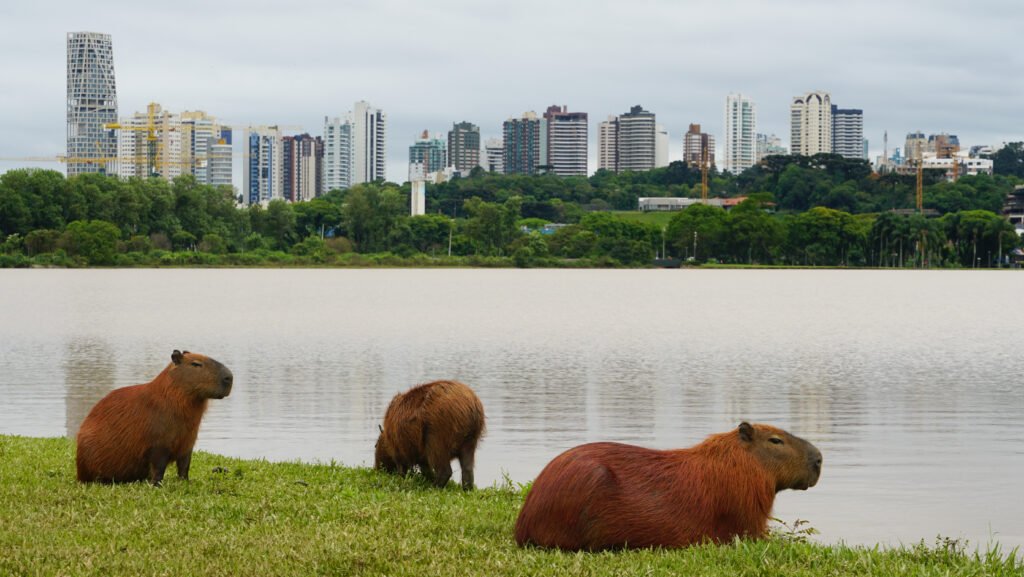
To put it simply, the capybara is the undisputed heavyweight champion of the rodent world. An adult greater capybara (Hydrochoerus hydrochaeris) typically reaches a length of 3.5 to 4.4 feet (1.06 to 1.34 meters). To visualize this, imagine a medium-to-large dog, like a Labrador Retriever, but with a much stouter, barrel-shaped body.
In terms of height, they usually stand about 20 to 24 inches (50 to 62 centimeters) tall at the shoulder. However, it is their weight that truly sets them apart. According to the National Geographic animal database, a healthy adult capybara generally weighs between 77 and 146 pounds (35 to 66 kilograms).
Interestingly, the ladies lead the way in this species. Female capybaras are typically slightly larger and heavier than their male counterparts. While the average weight hovers around 110 pounds, some big capybaras have been recorded reaching staggering weights of over 170 pounds in the wild, with one legendary female in Brazil reportedly tipping the scales at 201 pounds!
Why the “Water Pig” Needs Such a Large Frame
The scientific name for the capybara, Hydrochoerus, translates literally to water pig. While they aren’t related to swine, their large, heavy bodies serve a specific purpose in their semi-aquatic environment. Their size provides a level of thermal mass that helps them regulate their body temperature while spending hours submerged in the rivers and marshes of the Amazon and Pantanal.
Their massive, barrel-like torso is supported by short, sturdy legs, which are surprisingly powerful. Despite their bulky appearance, capybaras are not slow. In fact, when threatened by capybara natural predators like jaguars or pumas, these giant rodents can run as fast as a horse on land, reaching speeds of up to 21 miles per hour.
The Anatomy of Scale: Feet, Teeth, and Fur
Every inch of a big capybara is optimized for its lifestyle. Their feet are partially webbed, acting like natural paddles for swimming. Their eyes, ears, and nostrils are positioned high on their heads (much like a hippopotamus) allowing them to stay almost entirely submerged while still keeping a lookout for danger.
Another factor contributing to their giant status is their dental structure. As noted by the Natural History Museum, capybara teeth never stop growing. They must constantly gnaw on tough vegetation to wear them down. This specialized biology allows them to process massive amounts of food, fueling their large bodies and ensuring they remain the dominant herbivores in their marshy neighborhoods.
Capybara Diet: Fueling a 100-Pound Body
You might wonder what a rodent has to eat to reach the size of a human adult. The answer is a lot of greens! A capybara diet consists mainly of aquatic plants and grasses. On average, a single adult can consume 6 to 8 pounds (2.7 to 3.6 kilograms) of grass in a single day.
They are incredibly efficient eaters. Because grass is difficult to digest, capybaras have evolved a unique behavior called autocoprophagy, they eat their own morning feces to extract maximum nutrients and beneficial bacteria. This may sound unappealing to us, but it is the biological supercharge that allows them to grow so large on a diet of relatively low-calorie forage.
During the wet season, when food is abundant, capybaras put on significant weight. During the dry season, they may lose some of that bulk as they compete for limited resources. This seasonal fluctuation is a natural part of their life cycle in the wild.
Comparing the “Giant” to Other Rodents
To truly appreciate the scale of a world’s largest living rodent, it helps to compare them to their cousins. The second-largest rodent is the North American Beaver, which usually maxes out around 60 to 70 pounds. This means a large capybara can be more than double the size of the next largest species in its order!
While they share a family tree with the tiny guinea pig (which weighs a mere 1.5 to 2.5 pounds), the capybara has taken a very different evolutionary path. This island gigantism of sorts occurred in South America millions of years ago, leading to the emergence of even larger extinct relatives. For instance, the prehistoric Josephoartigasia monesi was roughly the size of a cow, weighing over a ton! While the modern capybara isn’t quite that big, it remains a formidable remnant of a time when rodents truly ruled the plains.
Growth and Maturity: From Pups to Giants
Capybaras grow remarkably fast. A newborn pup weighs only about 3 to 4 pounds, but it is precocial, meaning it can walk and eat grass within hours of birth. By the time they are 18 months old, a young capybara can already weigh over 80 pounds.
They generally reach their full adult size between 18 months and 2 years of age. In the wild, their life span is often cut short by predators, but in protected environments, they can live up to 10 or 12 years, maintaining their giant status throughout their senior years.
Summary Table: Capybara Size at a Glance
| Feature | Average Adult Measurement |
| Weight | 77 – 146 lbs (35 – 66 kg) |
| Length | 3.5 – 4.4 feet (106 – 134 cm) |
| Shoulder Height | 20 – 24 inches (50 – 62 cm) |
| Max Recorded Weight | 201 lbs (91 kg) |
The Magnitude of the Capybara’s Charm
Ultimately, the bigness of a capybara is about more than just physical dimensions. Their large size matches their outsized impact on their ecosystem and their massive presence in the hearts of animal lovers worldwide. Whether they are lounging in a hot spring or grazing on the riverbank, their giant nature is a testament to the diversity and wonder of the animal kingdom.
At Capybara Happiness, we celebrate every pound of these magnificent creatures. They remind us that nature doesn’t always fit into neat little boxes, sometimes, it builds a rodent the size of a dog and gives it the heart of a zen master.
Join us as we continue to explore the fascinating world of these gentle giants. From their massive teeth to their webbed toes, there is always something new to learn about the world’s largest, and perhaps most lovable, rodent!