
The Capybara, the world’s largest rodent, is famously known for its serene, chill persona and its dedication to soaking. Images of these massive, gentle creatures placidly sitting in water, often with only their eyes and nostrils visible, perfectly capture their tranquil nature. But the Capybara’s affinity for the water is far more than just a preference for relaxation; it’s a fundamental biological necessity tied directly to its survival, health, and social life in the wild.
The Capybara bath ritual is a complex behavior deeply rooted in their biology as semi-aquatic mammals. From regulating body temperature to evading apex predators, the daily dip is arguably the single most important activity in the life of the Capybara animal. This article explores the critical, often life-saving, reasons why these giants are never found far from a body of water.
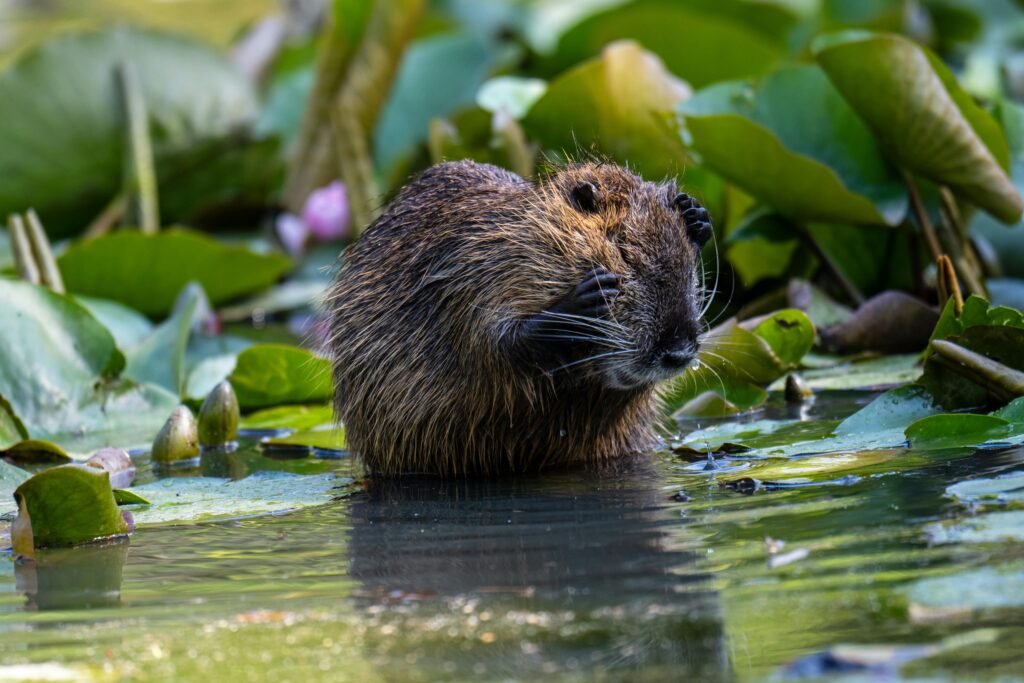
Thermoregulation: Beating the Tropical Heat
One of the most vital functions of the Capybara and its daily bath is managing body temperature in the often-scorching tropical and subtropical climates of South America. Capybaras inhabit regions where daytime temperatures can soar, posing a significant threat of overheating.
Unlike many mammals that sweat efficiently, the Capybara has very few sweat glands. Furthermore, their coat is thin and coarse, offering little protection from the intense solar radiation [Source: Capybara Physical Characteristics and Adaptation]. To combat hyperthermia, they rely almost entirely on behavioral cooling.
During the hottest hours of the day, from mid-morning through the afternoon, you will find Capybaras submerged in water. By soaking their large, dense bodies, they quickly dissipate excess heat, maintaining a safe and stable core temperature. Without this crucial escape to the water, a Capybara would quickly succumb to heat stroke.
Predator Evasion: The Water as a Sanctuary
The Capybara’s semi-aquatic lifestyle is also its primary defense mechanism against the host of predators that share its habitat, including jaguars, pumas, and ocelots on land, and caimans and anacondas in the water. The quick transition from land to water is often the difference between life and death.
The Submerged Hide
When threatened by a land predator, the Capybara animal bolts immediately for the nearest water source. They are powerful swimmers, aided by their partially webbed feet. Once submerged, they can use their elevated eyes, ears, and nostrils to hide with remarkable efficiency. This allows them to monitor the threat while remaining almost completely invisible, sometimes waiting for several minutes until the danger passes.
The Breath-Holding Advantage
Their capacity to hold their breath for up to five minutes adds another layer to their aquatic defense strategy. This allows them to swim discreetly away from a sighted predator, or simply remain hidden underwater longer than a typical terrestrial mammal could. This incredible adaptation turns the water not just into a retreat, but into an actively utilized defensive tool. You can read more about their strategies in our article on Capybara Evades Predation from Crocodiles.
Hygiene and Parasite Control
While a Capybara bath looks relaxing, it also serves a critical function in maintenance and hygiene. The Capybara’s skin is susceptible to drying out and suffering from various parasitic infestations, particularly ticks, which thrive in their grassy, low-lying habitats.
Regular soaking helps to hydrate the skin, preventing cracking and discomfort. More importantly, the water facilitates the removal of parasites. When a Capybara emerges from the water, they often shake off excess moisture and then engage in self-grooming. This process is often assisted by symbiotic partners.
Various bird species, such as the yellow-headed caracara, will land on the Capybara’s back while it rests or grazes. These birds act as natural pest control, feeding on the ticks and insects that embed themselves in the Capybara’s fur [Source: Symbiotic Relationships in the Capybara Ecosystem]. The combination of bathing and symbiosis is key to managing their parasite load and preventing disease transmission.
Social Cohesion and Reproduction
The water source acts as a vital social hub for the Capybara herd. Because they are highly social animals and must remain close to water for survival, the riverbank or swamp edge becomes the consistent location for the group to congregate, rest, and communicate.
Allogrooming and Bonding
The period after its bath, when they are resting near the water’s edge, is often spent engaging in allogrooming—mutual grooming between members of the herd. This activity is crucial for reinforcing social bonds, maintaining the herd hierarchy, and distributing natural oils across their coats.
Mating Rituals
Reproduction in Capybaras is also intrinsically linked to the water. Mating typically occurs in the water, as the female uses the water to control whether or not she wants to mate. If she doesn’t wish to engage, she simply swims away or submerges, thereby exerting choice and ensuring the dominant male cannot force the interaction [Source: Reproductive Behavior of the Capybara].
Nursing and Rearing of Young
For the young Capybara, the water is introduced immediately and becomes essential to their early life. Capy-pups are born precocial, meaning they are mobile and ready to join the herd within hours of birth.
Mothers will often give birth in relatively hidden areas close to the water. The pups learn to swim and dive almost immediately. They often take to the water on their mother’s back, a common and adorable sight, demonstrating their inherent comfort with the aquatic environment. The water provides safety for the entire herd, especially the vulnerable young, contributing significantly to their high survival rate.
The necessity of the Capybara bath underscores why ownership of a Capybara as a pet is so incredibly demanding. They cannot simply be kept in a dry enclosure; they require a large, clean, dedicated body of water as a non-negotiable part of their care. Their existence is proof that sometimes, the most important element of survival is simply knowing when and where to take a good, long soak.
This dependence on water means that conservation efforts focused on the Capybara must prioritize the protection and cleanliness of the South American wetlands. By safeguarding their aquatic homes, we ensure the continuation of their uniquely chill, water-bound existence. You can learn more about how to support these environments by checking out our page on Capybara Conservation Efforts.