
For most of the world, the capybara exists as a digital icon, a peaceful, unbothered silhouette appearing in slow-motion videos set to catchy music. However, when you step away from the screen and prepare for a face-to-face Capy encounter, the digital myth gives way to a much more complex and impressive biological reality. Seeing a capybara in real life is a sensory experience that often catches first-time observers off guard, from their surprising scale to the unique texture of their coat.
At Capybara Happiness, we believe that true appreciation comes from understanding the animal beyond the meme. Whether you are planning a sanctuary visit with the ambassador of chill or simply curious about the Water Pig, understanding their physical presence is the first step toward responsible advocacy. In this guide, we will break down the dimensions, textures, and behaviors that define the physical reality of these magnificent semi-aquatic rodents.
The Scale of the Giant: Witnessing the 140-Pound Cavy
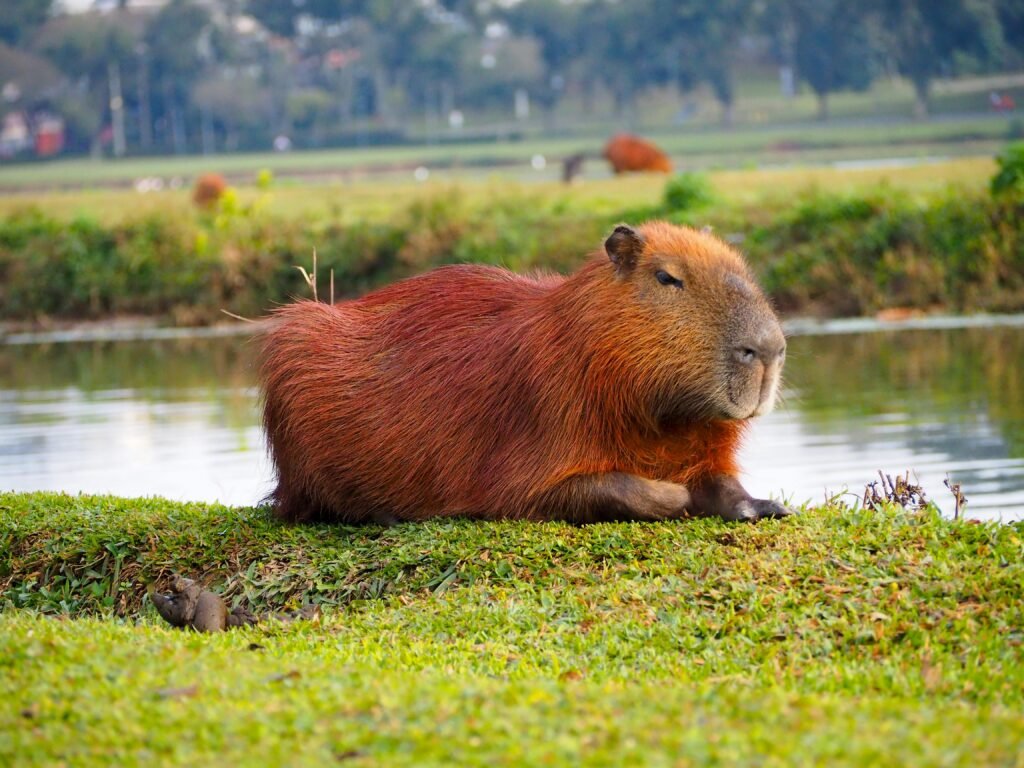
The first thing that strikes you when seeing a capybara in real life is their sheer size. While they are often compared to guinea pigs, the reality is that they are roughly 100 times the size of their domestic cousins. An adult capybara typically stands about 2 feet tall at the shoulder and can reach lengths of over 4 feet, making them comparable in size to a large dog like a Golden Retriever.
Witnessing the 140-pound cavy firsthand dispels the notion that they are small pets. According to the San Diego Zoo Wildlife Alliance, their barrel-shaped bodies are designed for maximum efficiency in the water, providing the buoyancy and muscle mass needed to navigate river currents. Their weight is concentrated in a low center of gravity, giving them a sturdy, almost immovable appearance when they are lounging.
This physical presence is part of why we emphasize the high cost of a capybara in terms of space and habitat. They are not animals that can live comfortably in a standard backyard, they require expansive areas that accommodate their massive frames and their need for a permanent water source. Seeing them move (a slow, deliberate walk that can transform into a 21-mph sprint) is a testament to their hidden power.
Texture and Touch: Touching the Coarse-Haired Giant
One of the most common surprises during a face-to-face Capy encounter is the texture of their fur. Many people expect a soft, plush feel similar to a rabbit or a cat, but touching the coarse-haired giant reveals something entirely different. Their hair is long, brittle, and sparse, feeling more like the bristles of a broom or the mane of a horse than soft down.
This coarse coat is an essential evolutionary adaptation for their semi-aquatic lifestyle. As noted by National Geographic, their fur does not hold water, instead, it allows moisture to drain away and air to circulate, which helps their skin dry quickly once they return to land. This prevents the animal from becoming waterlogged and heavy, ensuring they remain agile enough to escape predators like jaguars.
Beneath that shaggy exterior, their skin is surprisingly sensitive and prone to sunburn. This is why a capybara in real life spends so much time wallowing in mud or submerged in water. The mud acts as a natural sunscreen and parasite repellent. If you are lucky enough to participate in a supervised grooming session at a sanctuary, you will notice they lean into the scratches, often collapsing in a zen trance as they enjoy the physical interaction.
The Sensory World: Sight, Sound, and Smell
A capybara in real life is a highly communicative creature, though much of their language is lost in silent internet clips. When you are close to them, you will hear a constant stream of low-volume vocalizations. They purr when content, click to keep the herd together, and emit a sharp, dog-like bark when they sense danger. This auditory experience is a vital part of a sanctuary visit with the ambassador of chill.
Their faces are also masterpieces of specialized evolution. Their eyes, ears, and nostrils are positioned high on their heads, allowing them to remain almost entirely submerged while still monitoring their surroundings. This periscope head shape is a key feature of the webbed-footed wonder that allows them to hide from aerial and land-based predators simultaneously.
Smell is perhaps their most important sense for social bonding. Adult males have a prominent, dark, hairless gland on their snout called a morrillo. Seeing this gland in real life is fascinating, it secretes a waxy substance that the male rubs on plants and even other herd members to mark his territory and status. The scent is musk-like and distinct, acting as a chemical ID card within the complex social hierarchy of the herd.
Behavior in Person: The Quiet Intelligence
Internet videos often portray capybaras as stationary statues, but witnessing the 140-pound cavy in motion reveals a highly intelligent and curious animal. They are constantly sniffing the air, shifting their ears toward subtle sounds, and interacting with their environment. They are not dumb or slow, they are simply incredibly efficient with their energy.
During a sanctuary visit with the ambassador of chill, you might observe their unique grazing habits. They are autocoprophagous, a term used by the Britannica Encyclopedia to describe how they eat their own droppings to extract maximum nutrition from the tough grasses they consume. While this might sound unappealing to humans, it is a brilliant biological strategy that allows them to thrive on a diet that would be insufficient for other large mammals.
Their social intelligence is also palpable. They rarely move alone, and their interactions with one another involve subtle body language and mutual grooming. Seeing the way a dominant male protects the nursery of pups or how the herd moves as a single unit toward the water is a powerful reminder of their deep-seated pack instincts.
Respecting the Reality: Conservation and Advocacy
Understanding the physical reality of the water pig leads to a deeper respect for their conservation. When you see a capybara in real life, you realize they are not just content for our screens, they are a vital part of the South American ecosystem. As a keystone species, they manage vegetation and provide a food source for major predators, keeping the wetlands healthy and balanced.
According to the World Wildlife Fund (WWF), habitat loss and water pollution are the greatest threats to these animals. By engaging in a face-to-face Capy encounter at an accredited facility, you are often contributing to funds that protect their wild cousins in the Pantanal and Amazon basins. True advocacy means moving beyond the cute factor and supporting the environments that allow these giants to exist.
Final Thoughts: The Magic of the Encounter
There is an undeniable magic in seeing a capybara in real life. No 4K video can replace the feeling of standing near a creature that radiates such profound calmness. Whether you are touching the coarse-haired giant or simply observing their social dynamics from a distance, the experience is a humbling reminder of the diversity of the natural world.
We hope this guide has prepared you for your next (or first!) meeting with these incredible animals. By respecting their size, their specialized biology, and their social needs, we can ensure that every encounter is a positive one for both humans and capybaras.