
The Capybara animal is famed for its serene and relaxed demeanor, earning it the title of the “world’s chillest rodent.” Yet, life in the South American wetlands (the Capybara’s natural habitat) is far from a perpetual spa day. These gentle giants share their aquatic homes with some of the most formidable predators on the continent, particularly caimans (a species of crocodile) and anacondas. The Capybara’s survival is a masterclass in vigilance, strategy, and biological adaptation.
While we often see images of Capybara cute moments sharing a log with a turtle, their interactions with crocodiles are starkly different. This blog post explores the ingenious defense mechanisms the Capybara employs to minimize attacks and maximize its chances of survival against its scaly, toothy neighbors.
The Water is Not Just for Chilling: Aquatic Adaptation as Defense
The Capybara’s most crucial defense mechanism is its deep commitment to its semi-aquatic lifestyle. The species is obligatorily tied to water, meaning they must live near lakes, rivers, marshes, or swamps. This ecological necessity is their greatest tool against predators.
The Submerged Hide
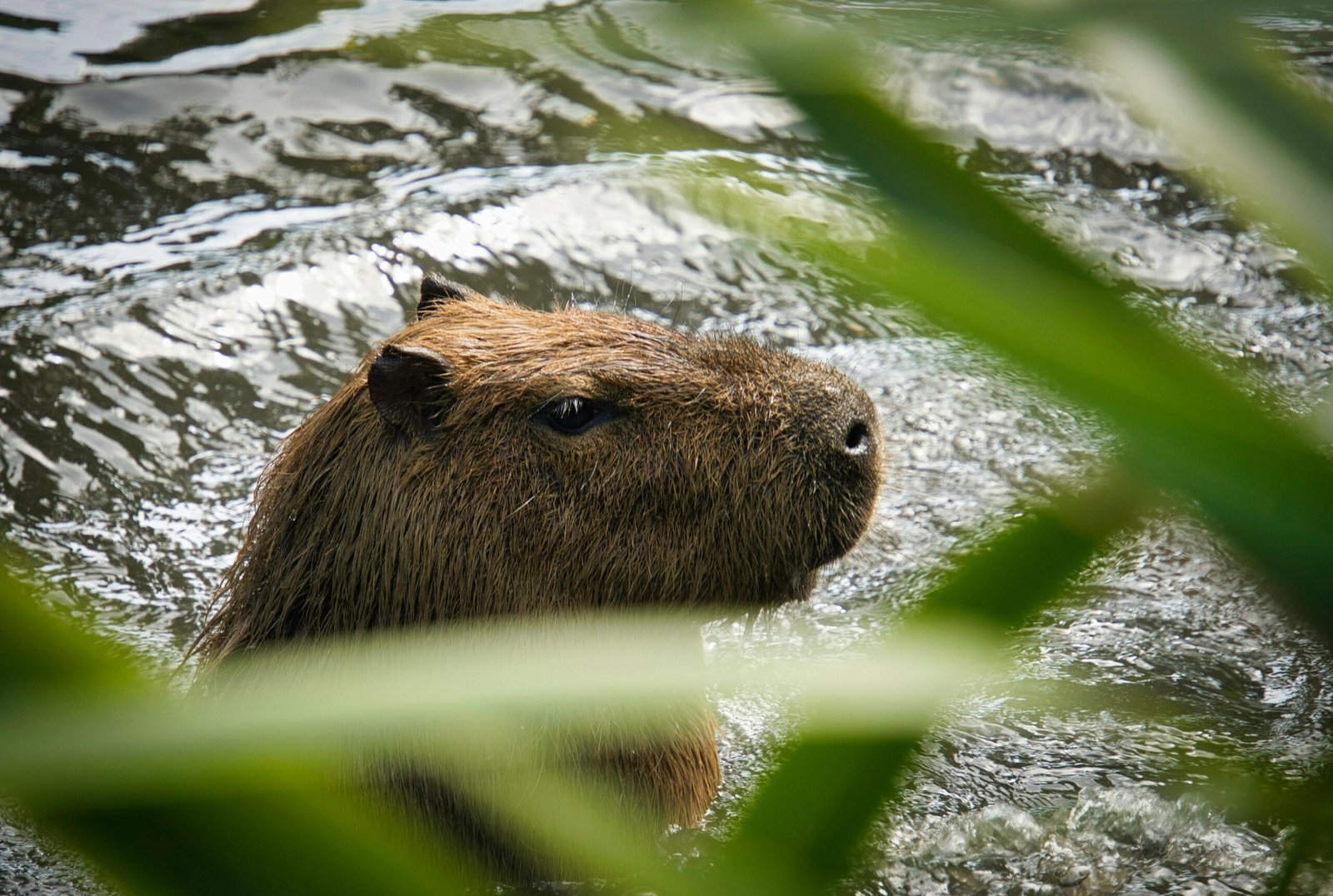
When a threat is sensed, a Capybara’s first instinct is not to flee inland, but to plunge into the water. Its powerful, partially webbed feet make it an excellent swimmer, allowing it to quickly outmaneuver many terrestrial hunters. Critically, their eyes, ears, and nostrils are positioned high on the head. This allows the Capybara to remain almost entirely submerged, with just its sensory organs above the surface, making it nearly invisible to a caiman or anaconda patrolling the water .
Breath-Holding Capability
Capybaras have the remarkable ability to hold their breath for up to five minutes. This allows them to stay underwater and wait out a predator, often swimming quietly away from the perceived threat along the bottom of the waterway. For large, opportunistic hunters like crocodiles, a Capybara that disappears beneath the surface for five minutes often isn’t worth the wait, as the crocodile might expend too much energy or miss an easier meal. This incredible physiological adaptation turns the water from a danger zone into a refuge.
The Strength in Numbers: Social Defense Strategy
The Capybara animal is an intensely social herd animal. While this characteristic is often cited as a reason they’d make a difficult pet if kept alone, in the wild, this herd mentality is a primary defense strategy, particularly against an ambush predator like a crocodile.
Vigilance and Sentinel Behavior
Capybara groups typically range from 10 to 20 individuals. Within the group, individuals often engage in sentinel behavior, where one or more members stand guard while the others graze or rest. Because there are many eyes watching, the chances of spotting a submerged caiman or an approaching land predator are significantly increased.
Alarm Communication
If danger is detected (a ripple in the water, or the sight of a crocodile approaching) the sentinel will issue a sharp, loud barking alarm. This distinctive vocalization instantly alerts the entire group, causing them to bolt either onto land or, more commonly, into the water for a collective dive. This immediate, synchronized action confuses and frustrates the predator, maximizing the chance of survival for the majority of the herd.
The Power of Perception: Avoiding the Ambush
Crocodiles, including the caiman species found in Capybara habitats, are classic ambush predators. They rely on patience and stealth, waiting for prey to come close to the water’s edge before launching a sudden, explosive attack. The Capybara’s survival relies heavily on breaking this ambush sequence.
Crepuscular Activity Pattern
Capybaras are crepuscular, meaning they are most active during the twilight hours of dawn and dusk. This is a strategic period; while it provides enough light for them to graze effectively, it is often dark enough to grant them some cover against visual hunters. However, Capybaras will graze throughout the day if the temperature is cool or if they are near safe water refuge.
Grazing Distance
Herds generally maintain a safe grazing distance from known predator hotspots, like deep, murky bends in a river or dense, shadowed banks. They prefer to graze in open, low-vegetation areas, which provide clear lines of sight, minimizing the likelihood of a crocodile being able to sneak up unnoticed [Source: Predator-Prey Dynamics in the Pantanal].
Size, Agility, and Scapegoat Survival
While not their primary defense, the Capybara’s large size and surprising agility provide a final, desperate line of protection. A full-grown Capybara is a formidable meal, and sometimes, its sheer size can deter smaller caiman species.
Fast Land Escapes
While they look clumsy, Capybaras can reach surprisingly high speeds, up to (35km/h or 22mph) in a burst of speed when galloping toward the water. If a crocodile attacks on land, the Capybara’s heavy build and solid structure mean it can deliver a powerful kick, though this is a last resort.
The Herd Sacrifice (Scapegoat Effect)
In a massive, group dive into the water, a crocodile’s attack is often focused on the nearest, most accessible animal. While unfortunate for the individual, the herd structure means that the focus on a single Capybara allows the rest of the group to escape and survive. This is an unavoidable part of the Animal Capybara Ecology, where group vigilance minimizes risk for the whole.
The Capybara’s survival alongside dangerous predators like crocodiles is a brilliant example of ecological balance. Their defense is not based on fighting prowess, but on sophisticated social structures, vigilance, and superior biological adaptations to their wetland environment. The Capybara is the ultimate chill animal precisely because it has mastered the art of non-confrontational survival.
Ultimately, the Capybara’s success against the bite of the crocodile comes down to being smarter, chiller, and faster at getting into the water than their ancient, reptilian neighbors [Source: The Role of Capybaras in the Food Chain].